

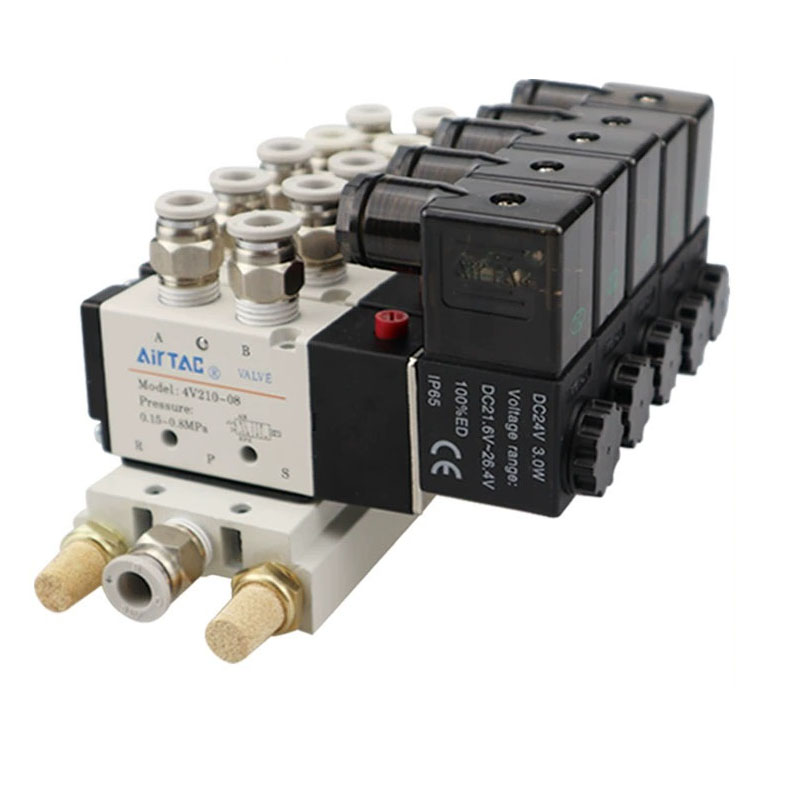
A 5/2 manner solenoid valve is generally used to govern air or fluid go with the flow in pneumatic or hydraulic structures. It has five ports and positions (consequently the call 5/2), and it's far on the whole used to control double-performing cylinders. right here's the way it works:
Ports (5 in overall):
P (pressure port): The inlet for pressurized air or fluid.
A (working port A): one of the two ports related to the cylinder.
B (working port B): the alternative port connected to the cylinder.
EXH1 (Exhaust port 1): Exhaust for port A.
EXH2 (Exhaust port 2): Exhaust for port B.
Coils: There are usually two solenoids (electromagnetic coils) that control the valve's moving. every solenoid is activated or deactivated to transport the valve's internal spool among positions.
function 1 (usually Closed):
The P (strain port) is connected to A (working port A), and B (working port B) is hooked up to EXH2 (exhaust port 2).
This position generally extends the cylinder (pushes the piston in the double-appearing cylinder).
function 2 (Shifted position):
The P (strain port) is hooked up to B (working port B), and A (working port A) is connected to EXH1 (exhaust port 1).
This function commonly retracts the cylinder (pulls the piston returned).
when the solenoid coil is energized, it shifts the internal valve spool from role 1 to put 2 (or vice versa).
In position 1, pressurized air or fluid flows into port A to extend the actuator, at the same time as port B is exhausted.
In role 2, the pressurized air or fluid flows into port B to retract the actuator, whilst port A is exhausted.
The 5/2 manner solenoid valve lets in you to manipulate the path of go with the flow in a double-performing cylinder or actuator, shifting the valve to exchange among positions (expand and retract) based totally on solenoid activation. It's called "5/2" because it has 5 ports and two possible states (positions).


